Tetons in the Fall: Day 2 - An Unexpected Detour to Yellowstone
This one is a long one, because any day that starts with waking up at 4am and not returning to the hotel room until nearly 9pm is a long day. So buckle up or skim the sub-headers. Its a choose your own novel sort of photo-adventure read. Thanks for tagging along!
A Choice to be Made
The night before our first full day of photography, we asked Evan what the plan was for the following day. He got this almost childlike grin on his face. You could tell he was excited about something.
Our original plan was to spend the day exploring Grand Tetons National Park, but the unusually warm October weather was proving to be a challenge. Mornings were starting out cold, with temperatures in the mid-30s, but by midday they were climbing into the upper 70s and even low 80s. Not exactly the kind of weather you hope for when you're searching for large mammals. As temperatures rise, animals often seek shade and become less active, making them harder to find and photograph. And even when you do find them, the heat presents another challenge. Warm air rising off the ground creates heat shimmer, distorting details and making it difficult to capture sharp photographs, particularly at longer distances.
Evan had an idea.
Instead of spending the next day in the Tetons, we could head north into the southern end of Yellowstone National Park, where temperatures were expected to be cooler. He'd been receiving consistent reports of grizzly bear activity in the area and also knew of a location where great gray owls had been active.
He laid out the possibilities, along with the very real chance that we could spend the entire day searching and come away with nothing. But you could see how excited he was about the opportunity. His smile and energy was contagious.
Then someone asked what time we'd need to leave. He seemed almost reluctant to say it, knowing just how early it was going to be. With a little bit of a smiling wince he squeaked out, ‘5am’. There was no hesitation. We all agreed to meet at 5am to head north. The possibility of photographing either species was exciting, and one I had not anticipated. Having an opportunity for one, if not both, was hard to pass up.
A Great Gray Owl Adventure
At 5am the next morning, we were on our way. We made a brief stop along Yellowstone Lake before sunrise. The lake was like glass stretching out to mountains, the morning was still and quiet, and a crescent moon hung above the landscape. It was one of those peaceful moments that makes getting up at four in the morning a little easier. But we had a destination in mind, and we were eager to see whether the reports of great gray owls would pan out.
When we arrived, there were already several cars and photographers gathered near the area. Usually, an encouraging sign, except most of them were packing up and leaving. Not quite what we'd hoped to see.
A few photographers remained in the woods with their cameras pointed toward the trees, which gave us a little hope. Apparently, a great gray owl had been hunting near the roadside but had recently flown into the forest. Nobody seemed entirely sure where it had gone. ‘Up for a hike?’ Evan asked? Of course! We hadn’t come all this way for nothing. So we set off into the woods. Not too far in, Brian and I spotted another photographer standing on a hillside above us, camera raised. Bingo.
I wasn't entirely sure of the etiquette in this situation. I'm not accustomed to photographing wildlife around so many other photographers, and the last thing I wanted was to crowd someone who had already found a good position. I followed Evan's lead as we made our way up the hillside, keeping a respectful distance behind the photographer.
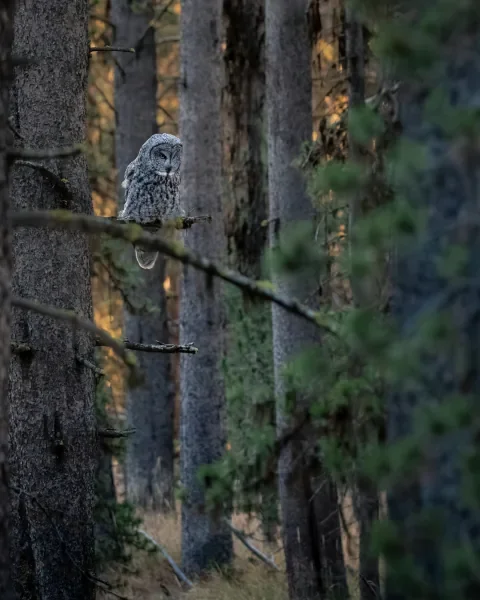
And there it was.
Perched on a small branch, maybe eight feet above the ground, was the largest owl I'd ever seen. A great gray owl. We were standing in a dense pine forest, surrounded by towering trees. The morning sunlight filtered through the canopy, catching the edges of the owl's feathers while much of the forest remained in shadow. Beneath our feet, a thick, spongy layer of forest debris seemed to absorb every sound.
Standing over two feet tall, great gray owls are among the tallest owls in the world (by height). But knowing that and actually seeing one in person are two very different things.
We spent the next thirty minutes watching it hunt. It would sit motionless on a branch, occasionally tilting or turning its head as it listened for movement below. Then, without warning, it would dive toward the forest floor before emerging again and finding another perch farther into the trees. We never saw it catch anything, but watched it make three hunting attempts.
What amazed me most was the silence. For such a large bird, its flight was almost completely soundless. If you hadn't been watching, you might never have known it had moved. I found myself completely absorbed in the encounter. The other photographers, the awareness of everything happening around me, all seemed to fade away. For a little while, my entire attention was on this magnificent bird and the way it moved through the trees.
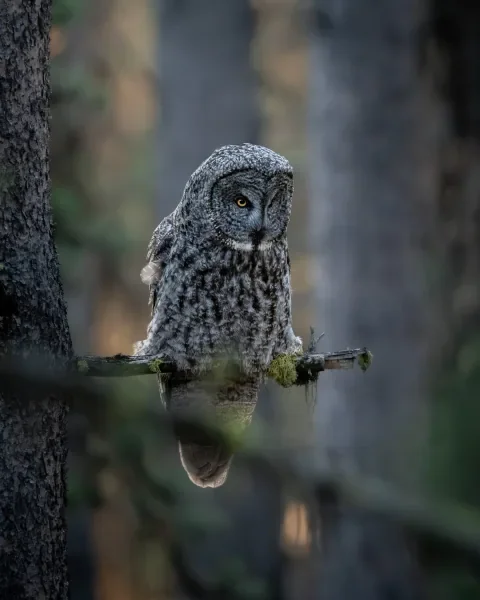
There was something almost mystical about the experience. Standing in that quiet forest, watching an enormous owl move so effortlessly and silently among the trees, it wasn't difficult to understand why these birds have inspired so much mythology and folklore throughout history.
After its third hunting attempt, we decided it was time to leave. Although the owl didn't appear disturbed by our presence, it continued moving farther into the forest, and we didn't want to follow it from perch to perch, feeling as though we were chasing it. We'd had an incredible opportunity to observe and photograph it, and there was no reason to push for more.
I walked out of that forest with photographs I'm genuinely proud of and the memory of an encounter I won't soon forget.
In search of a Grizzly Bear
With our owl encounter behind us, we continued our search for grizzly bears. Evan knew of several bears that had been seen regularly in the area, and we kept an eye out as we traveled farther into Yellowstone. Then he received word of a nearby wolf sighting. The wolves were going to be too far away to photograph, but there was a chance we might be able to see it through a spotting scope. We arrived to find a small group of people standing on a hillside, looking down into a rolling meadow.
Through a pair of binoculars I was able to make out a black wolf in the distance. It wasn't much more than a dark speck against the landscape, but it was unmistakably a wolf. Even at that distance, it was exciting to see one. There had also been reports of two grizzlies near a carcass in the area, but neither was visible while we were there. After everyone got a chance to see the wolves we decided to continue on in hopes of finding more photograph-able opportunities.
A little farther down the road, bear management personnel were stationed near Yellowstone Lake. There was a possibility that one of the bears might move toward the road, so we decided to wait. Since bear management was confident enough to setup a lookout, we decided hold tight for awhile to see what would pan out. We spent a little over an hour along the lakeshore, taking an early lunch, enjoying the scenery, and keeping watch.
Eventually, the bear management team departed, and we decided it was time to move on as well.
Big Horn Sheep! An Unexpected Encounter
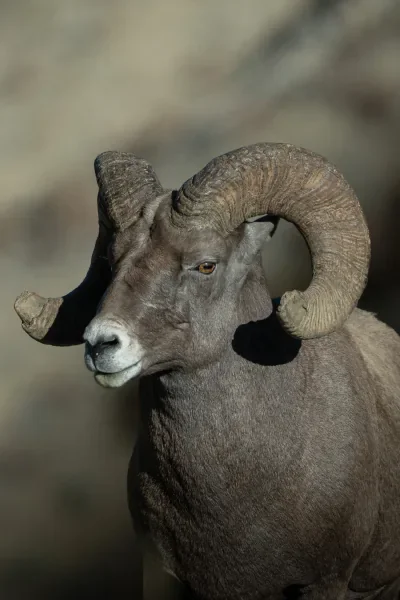
If you’ve followed my photography you may have caught on that I love Bighorn Sheep. They have a relatively consistent presence in Flaming Gorge and I love to go sit and photograph them whenever I get the chance. However, its been a really hot and dry year, and they haven’t been showing up in the usual places. My unconfirmed guess is they’re spending more time in canyon shade and drainages where the little water we did get collects and allows the right vegetation to grow, but I’m not certain. I just know that I haven’t seen them as much so when we rolled up on this little clan that had two nice size rams I was stoked! The rams stayed along the road, not ideal for the shots I was hoping to get but I managed to capture a decent portrait of one of the rams.
Pikas!
I'm not sure which I was more excited about—the bighorn sheep we'd just encountered or the opportunity to photograph pikas. Pikas are small mammals that look a bit like oversized, chubby hamsters. They live in rocky alpine environments, where winters are long, temperatures are bitterly cold, and snow can bury the landscape for months at a time. But unlike many small mammals living in these conditions, pikas don't hibernate. Instead, they spend much of the summer preparing for winter, gathering grasses and other vegetation, spreading it out on rocks to dry, and storing it in large hay piles that will sustain them through the colder months.
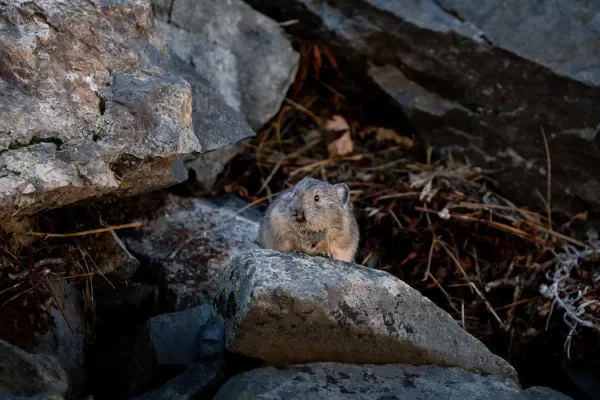
I'd already been researching places closer to home where I might photograph these little creatures, and they were high on my wish list for next year. So getting an unexpected introduction in Yellowstone was pretty exciting.
We heard them before we saw them. A sharp, high-pitched chirp echoed from somewhere among the rocks. It took a little while to pick out their movements, but eventually I spotted one scurrying across the talus. Their coloring blended so well with the surrounding rocks that it was surprisingly easy to lose sight of one the moment it stopped moving.
I watched as they darted in and out of the spaces between the rocks, hoping to capture one collecting vegetation for its winter hay pile. That opportunity never presented itself, but I did manage to photograph a pika resting just outside its shelter, with a large hay pile tucked among the rocks behind it.
A Grizzly Bear Named Doug
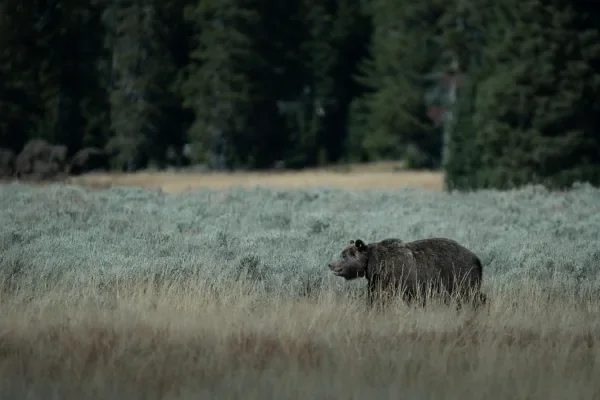
Eventually, we returned to the area where grizzlies had been reported earlier in the day. Bear management personnel were present once again, along with a small crowd of visitors. And there, several hundred yards away on a hillside, was a grizzly bear known as Doug. He was identifiable by the tags in both ears and a tracking collar.
It was the middle of a warm afternoon, and the photographic conditions were terrible. Between the distance and the heat shimmer, I knew I wasn't going to come away with the kind of grizzly photographs I'd hoped for. But seeing a wild grizzly was still exciting.
As we continued watching, though, the encounter became more complicated. We came to understand that an elk carcass had been near Yellowstone Lake overnight but had since been removed. Doug appeared intent on reaching that area, repeatedly moving toward the road. Bear management personnel were preventing him from crossing and using what appeared to be projectile-based hazing equipment to turn him away. We watched as he paced and panted in the afternoon heat.
It was difficult to see.
The group wondered aloud together if clearing people out of the area and allowing him to cross might have been a better approach. But I also recognized that we didn't have all the information behind the decisions being made. Managing wildlife in a national park, especially large predators around busy roads and crowds of visitors, involves challenges that aren't always obvious to those of us watching from the sidelines.
It wasn't the kind of grizzly encounter I'd imagined when we set out that morning.
And while I did take a few photographs, they're mostly keepsakes from the experience rather than images I'd consider sharing in my portfolio. Still, it was an encounter that stayed with me, both for the excitement of seeing a grizzly and for the questions it raised about the complicated relationship between wildlife and people in our national parks.
Sunset at Blacktail Pond
Once Doug retreated up the hillside, discouraged by the hazing efforts and the heat of the afternoon, we piled back into the van and began the drive toward Jackson. Just as the sun was setting, we noticed a small crowd gathered at Blacktail Pond Overlook in Grand Tetons National Park. Naturally, we had to stop and see what had everyone's attention.
There, standing in the pond, was a bull moose grazing leisurely in the fading evening light. He was fairly distant, so rather than trying to fill the frame, I decided to take the opportunity to photograph him within the surrounding landscape. I'd been wanting to experiment more with environmental wildlife photography, and this seemed like a good opportunity.
The photographs didn't quite turn out the way I'd envisioned, but I wasn't too disappointed. After all, it was only day two, and if the past twenty-four hours were any indication, there would be plenty more opportunities ahead.
As we wrapped up the day, I found myself thinking about everything we'd seen. A great gray owl, wolves, bighorn sheep, pikas, a grizzly bear, and now a bull moose. We'd set out that morning with an early alarm, a long drive, and absolutely no guarantees. Yet somehow, Evan just kept finding opportunities for us. By the end of the day, we'd started teasing him about having "Snow White Syndrome"—as though every woodland creature could sense his presence and would simply wander out of the forest to pose for his camera. Evan just laughed it off, seemingly a little embarrassed by all the attention. He eventually accepted the teasing with a smile, as though finding that much wildlife in a single day was nothing out of the ordinary. Maybe to him it wasn't. But to me, it was pretty remarkable.
I live in an area teeming with wildlife and surrounded by beautiful landscapes. I'm fortunate to have opportunities to encounter wildlife regularly, but days like this are few and far between. I know firsthand how much patience, persistence, and sometimes plain luck goes into finding these animals. And I think that made me appreciate Evan's knowledge and experience all the more.
I was exhausted, but incredibly grateful. And with three more days ahead, I couldn't help but wonder what else was waiting to be discovered.